
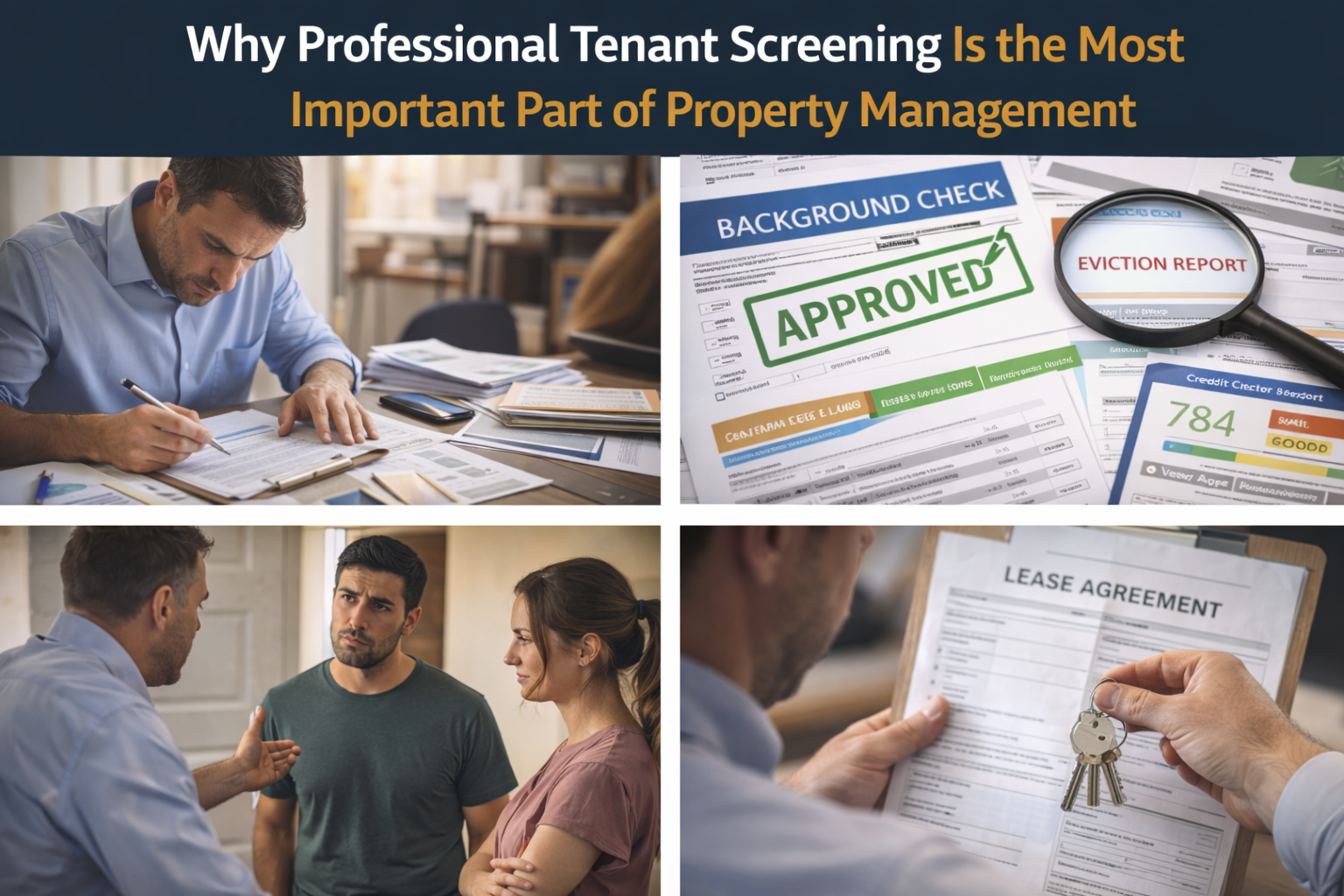
Why Professional Tenant Screening Is the Most Important Part of Property Management
If property management had a single point of failure, tenant screening would be it. You can have a great property, strong rent demand, and solid systems in place—but if the wrong tenant is placed, everything else quickly unravels.
Late payments, property damage, legal disputes, and costly turnover almost always trace back to one decision: who was approved to move in. That’s why professional tenant screening is widely considered the most important part of property management—and why experienced investors never treat it casually.
This article explains why tenant screening matters so much, where self-managing landlords often go wrong, and how professional screening directly protects cash flow, property condition, and long-term ROI.
Tenant Quality Drives Everything That Follows
Once a tenant moves in, nearly every aspect of property performance depends on that individual.
Tenant quality impacts:
Rent payment consistency
Property care and maintenance issues
Neighbor complaints and disturbances
Lease compliance
Turnover frequency
Legal exposure
A strong tenant makes management easier and more predictable. A poor tenant turns even a great property into a constant problem.
The Real Cost of a Bad Tenant
Many landlords underestimate how expensive a bad tenant can be.
The true cost often includes:
Missed or late rent
Legal fees and eviction costs
Property damage beyond the deposit
Vacancy during turnover
Cleaning and repair expenses
Time and stress
One poorly screened tenant can easily wipe out a full year of profit—or more.
Why DIY Screening Fails So Often
Self-managing landlords often rely on incomplete or inconsistent screening methods.
Common mistakes include:
Overvaluing credit score alone
Ignoring rental history or eviction records
Accepting unverifiable income
Rushing approval to avoid vacancy
Making emotional or subjective decisions
In many cases, landlords approve tenants based on likability instead of data—introducing unnecessary risk.
Professional Screening Is About Consistency and Compliance
Professional tenant screening isn’t just more thorough—it’s consistent and legally compliant.
Professional property managers use standardized criteria that include:
Verifiable income ratios
Credit evaluation within fair housing guidelines
Rental history confirmation
Eviction and public records checks
Identity verification
Consistency protects landlords from discrimination claims while ensuring every applicant is evaluated fairly and objectively.
Income Verification Is More Important Than Credit
Credit scores tell only part of the story. Many tenants with decent credit still struggle to pay rent consistently.
Professional screening emphasizes:
Stable, verifiable income
Appropriate income-to-rent ratios
Employment consistency
Income verification is often the single strongest predictor of on-time rent payments.
Rental History Predicts Future Behavior
Past behavior is one of the best indicators of future behavior.
Professional screening looks closely at:
Prior landlord references
History of late payments
Lease violations
Property care habits
Tenants who respected previous rentals are far more likely to respect yours.
Eviction History Is a Major Red Flag
Evictions don’t happen randomly. While there are rare exceptions, a history of eviction often signals higher risk.
Professional tenant screening:
Identifies eviction filings and outcomes
Weighs recency and patterns
Applies consistent approval standards
Failing to check eviction history is one of the most common—and costly—screening oversights.
Fair Housing Compliance Is Not Optional
Tenant screening must comply with federal, state, and local fair housing laws. Violations can occur unintentionally if screening criteria are inconsistent or improperly applied.
Professional property management:
Uses legally reviewed screening standards
Applies criteria uniformly
Documents decisions properly
Reduces exposure to discrimination claims
Compliance protects landlords from lawsuits that can be far more expensive than any vacancy.
Good Screening Reduces Turnover
High turnover is expensive. It increases vacancy, maintenance, and marketing costs.
Well-screened tenants:
Stay longer
Pay more reliably
Create fewer disputes
Reduce wear and tear
Lower turnover directly improves net operating income and ROI.
Screening Is Where ROI Is Won or Lost
Many landlords focus heavily on:
Purchase price
Rent amount
Management fees
But tenant screening has a greater impact on ROI than all three combined.
A slightly lower rent with a high-quality tenant often outperforms higher rent with chronic issues and turnover.
Why Professional Property Managers Treat Screening as Non-Negotiable
Professional property managers understand that screening mistakes are expensive and difficult to fix after move-in.
That’s why screening is:
Structured
Documented
Data-driven
Non-emotional
Once a tenant is placed, options become limited. Screening is the last point where risk can be controlled.
Final Thoughts: Everything Starts With the Right Tenant
Property management success doesn’t start with rent collection or maintenance—it starts with who gets the keys.
Professional tenant screening:
Protects income
Preserves property condition
Reduces legal exposure
Improves long-term returns
For landlords who care about ROI, stability, and peace of mind, tenant screening isn’t just important—it’s foundational.
Choosing professional screening is one of the smartest decisions a property owner can make.