
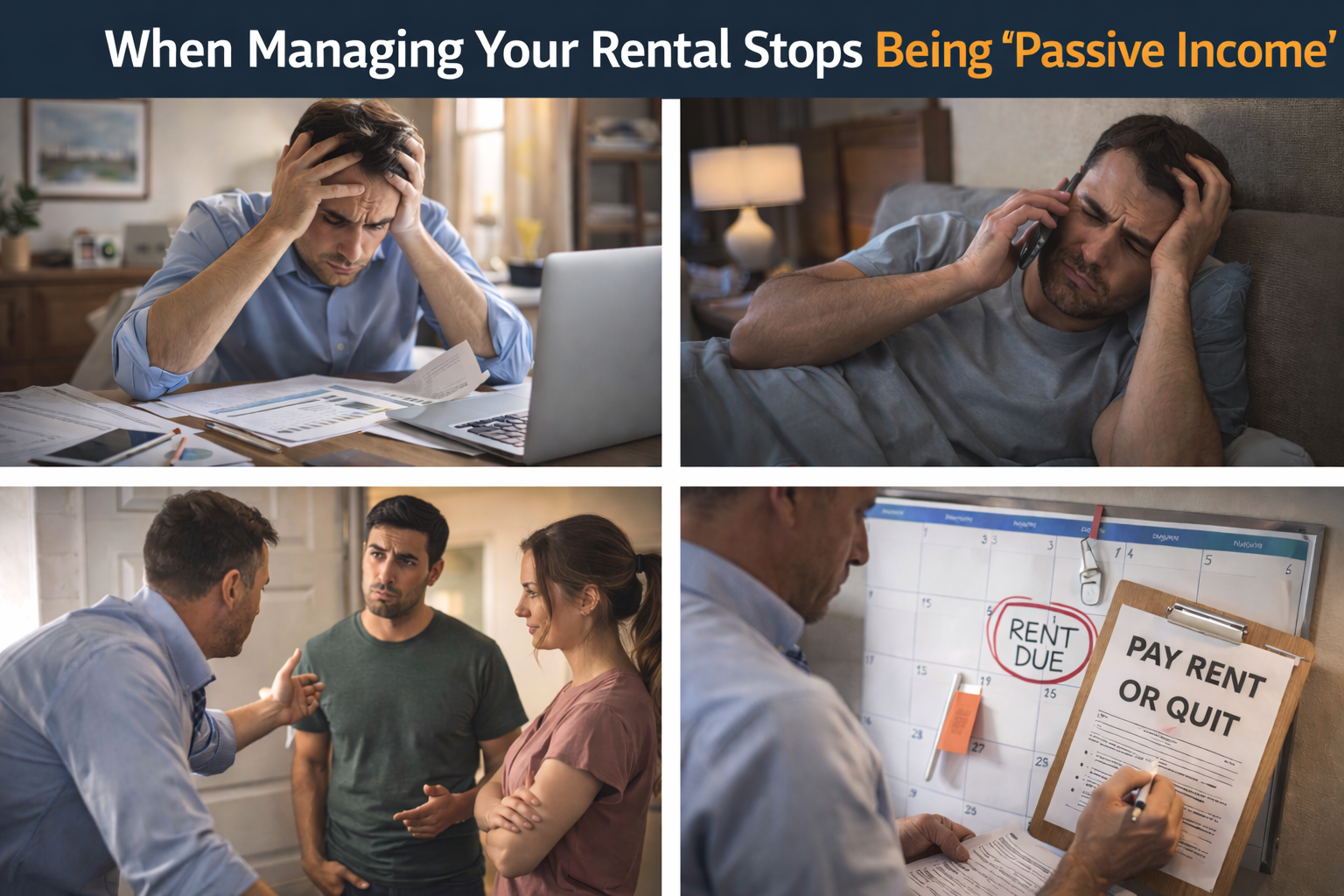
When Managing Your Rental Stops Being “Passive Income”
Real estate is often marketed as passive income—a hands-off investment that produces monthly cash flow with minimal effort. Many landlords buy their first rental property believing this promise, only to discover later that managing a rental can feel more like a second full-time job than a passive investment.
The truth is, rental property only remains passive until management demands outweigh the return. This article explains when and why managing your rental stops being passive income, the warning signs landlords often ignore, and what to do when ownership becomes more work than reward.
The Myth of Passive Income in Rental Real Estate
There is a version of real estate investing that can be relatively passive—but it rarely involves self-managing for long.
Self-managing landlords quickly take on roles such as:
Leasing agent
Maintenance coordinator
Accountant
Legal compliance officer
Customer service representative
Each role alone requires time and attention. Combined, they turn “passive income” into an active operation.
The First Warning Sign: Your Time Is Constantly Interrupted
One of the earliest indicators that your rental is no longer passive is constant interruption.
This often looks like:
Tenant texts during work hours
Emergency calls at night or on weekends
Repeated follow-ups for maintenance
Rent questions and disputes
When your phone becomes a 24/7 support line, your rental income is no longer passive—it’s demanding.
Maintenance Turns Passive Income into Active Work
Maintenance is one of the biggest factors that shifts rentals from passive to active.
Even minor issues require:
Diagnosing the problem
Contacting vendors
Scheduling repairs
Following up on completion
Managing invoices
As properties age, maintenance volume increases. What once felt manageable slowly becomes overwhelming.
Compliance and Legal Risk Add Hidden Work
California landlord-tenant laws are complex and constantly changing. Staying compliant requires ongoing attention.
Self-managing landlords must:
Track notice requirements
Handle security deposits correctly
Stay current on rent control laws
Document inspections and communications
Compliance work is invisible until something goes wrong—then it becomes urgent, stressful, and expensive.
Vacancy and Turnover Accelerate the Workload
Vacancy doesn’t just reduce income—it multiplies effort.
Each turnover creates:
Cleaning and repair coordination
Marketing and showings
Applicant screening
Lease preparation
If turnover increases, so does your workload. At that point, the property is no longer passive—it’s reactive.
Emotional Decision-Making Increases Stress
When landlords self-manage, emotions often enter decision-making.
Common scenarios include:
Giving tenants extra chances
Delaying rent increases
Avoiding difficult conversations
Putting off enforcement
These choices often increase workload and reduce income, making management even more hands-on.
Scaling Breaks the Passive Illusion
Many landlords can self-manage one property—for a while.
But as portfolios grow:
Tenant communication multiplies
Maintenance volume increases
Accounting becomes more complex
Legal exposure expands
At a certain scale, self-management stops being realistic without sacrificing time, focus, or sanity.
The Cost of “Free” Management
Self-managing often feels cheaper because there’s no management fee. But the true cost is rarely calculated.
Hidden costs include:
Time spent managing issues
Lost income from vacancy
Stress and burnout
Missed investment opportunities
When you factor in these costs, “free” management is often far more expensive than professional help.
When Passive Income Becomes a Business
The moment your rental requires systems, schedules, vendors, documentation, and constant oversight, it has become a business.
Businesses can be profitable—but they are not passive.
The key question becomes:
“Do I want to run a property management operation, or do I want to invest in real estate?”
How Professional Property Management Restores Passivity
Professional property management exists to return rentals to a passive state.
By delegating operations, landlords regain:
Time freedom
Predictable cash flow
Reduced legal exposure
Emotional distance from tenant issues
Instead of reacting to problems, investors can focus on strategy and growth.
Final Thoughts: Passive Income Requires Active Decisions
Rental property doesn’t become passive by accident—it becomes passive through intentional delegation.
When managing your rental stops being passive income, it’s not a failure—it’s a signal. A signal that your investment has grown beyond DIY management.
The most successful landlords recognize this moment and make the shift from operator to investor.