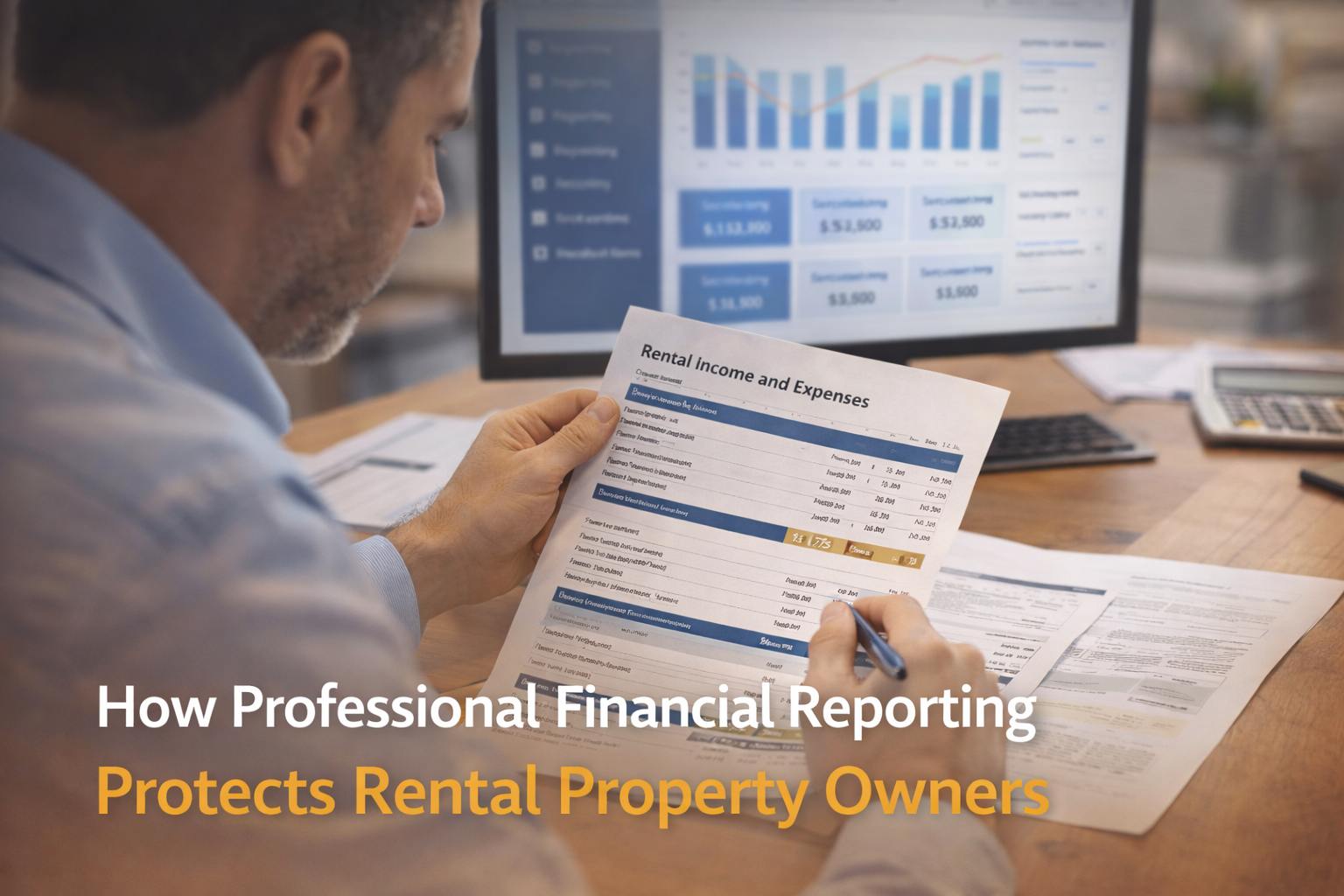
How Professional Financial Reporting Protects Rental Property Owners
For many landlords, rental property ownership is about cash flow, appreciation, and long-term wealth. But those outcomes depend on one critical factor that often gets overlooked: accurate, professional financial reporting.
Without clear financial visibility, rental properties become vulnerable to mistakes, missed opportunities, tax issues, and even legal risk. Professional financial reporting isn’t just about tracking numbers—it’s about protecting rental property owners by providing clarity, accountability, and control.
This article explains how professional financial reporting works, why it matters, and how it safeguards both short-term income and long-term investment performance.
Financial Reporting Is the Backbone of Rental Property Ownership
Rental properties are businesses—whether landlords treat them that way or not. Every business relies on accurate financial reporting to operate successfully.
Professional financial reporting provides:
Clear tracking of income and expenses
Transparency into property performance
Documentation for tax and legal purposes
Early detection of issues before they escalate
Without reliable reporting, landlords are often managing blind.
Protecting Owners From Cash Flow Surprises
One of the biggest risks landlords face is unexpected cash flow shortfalls.
Poor or inconsistent reporting can hide:
Rising maintenance costs
Late or missing rent payments
Vendor overcharges
Duplicate or incorrect expenses
Professional financial reporting creates real-time awareness of what’s happening financially, allowing owners to:
Spot negative trends early
Adjust strategy before losses grow
Maintain predictable cash flow
Surprises are expensive. Visibility prevents them.
Accurate Reporting Prevents Costly Errors
Errors in rental accounting are more common than many landlords realize—especially when self-managing.
Common mistakes include:
Misapplied rent payments
Incorrect owner distributions
Missing expense entries
Poor categorization of repairs vs. capital improvements
Professional reporting systems are structured to reduce human error through standardized processes and reconciliations. This protects owners from inaccurate balances, disputes, and accounting headaches.
Financial Transparency Builds Trust and Accountability
When property owners work with vendors, tenants, or property managers, trust is critical. Professional financial reporting creates a transparent record that protects all parties.
Clear reporting:
Shows exactly where money is going
Documents why deductions were made
Provides evidence if disputes arise
Creates accountability for management decisions
Transparency protects owners from misunderstandings and builds confidence in how their investment is being handled.
Strong Reporting Simplifies Tax Preparation
Tax season is stressful enough without scrambling to reconstruct a year’s worth of financial activity.
Professional financial reporting provides:
Clean year-end summaries
Clearly categorized income and expenses
Documentation to support deductions
Easier collaboration with CPAs and tax professionals
Well-prepared reports reduce tax prep time, lower accounting costs, and minimize the risk of filing errors or audits.
Financial Reporting Protects Against Legal Disputes
Rental properties operate in a heavily regulated environment. Financial documentation often becomes evidence in disputes involving:
Security deposits
Rent disputes
Maintenance charges
Owner-manager disagreements
Professional financial reporting creates a defensible paper trail that protects owners if issues escalate. When records are accurate, timely, and complete, landlords are far less exposed.
Performance Tracking Improves ROI Over Time
Professional financial reporting isn’t just backward-looking—it’s a strategic tool.
Consistent reports allow owners to:
Track net operating income (NOI)
Compare performance year over year
Identify underperforming properties
Make data-driven decisions
This level of insight helps landlords optimize rents, control expenses, and improve ROI across their portfolio.
Owner Portals Add Real-Time Protection
Modern professional property management includes secure owner portals that provide 24/7 access to financial information.
Owner portals typically offer:
Monthly statements
Real-time balances
Repair invoices and receipts
Payment histories
Year-end reports
Immediate access protects owners by eliminating delays, confusion, and reliance on verbal updates.
Financial Reporting Reduces Emotional Decision-Making
When landlords don’t have clear financial data, decisions often become emotional or reactive.
Professional reporting replaces guesswork with facts:
Rent increases are based on numbers, not feelings
Maintenance decisions are evaluated by cost and impact
Investment decisions are grounded in performance metrics
Clear data leads to better decisions—and better outcomes.
Why Professional Reporting Matters More as Portfolios Grow
As rental portfolios scale, financial complexity increases quickly.
Multiple properties mean:
More tenants
More vendors
More transactions
More compliance requirements
Professional financial reporting systems scale efficiently, protecting owners from chaos as their investments grow.
Self-Management vs. Professional Financial Reporting
Self-managed landlords often rely on:
Spreadsheets
Bank statements
Incomplete records
While this may work temporarily, it rarely provides the accuracy or protection needed long-term.
Professional reporting offers:
Standardized processes
Monthly reconciliations
Clear audit trails
Consistent documentation
The difference is not just convenience—it’s risk reduction.
Final Thoughts: Clarity Is a Form of Protection
Rental property owners face enough risk without adding financial uncertainty to the mix. Professional financial reporting protects landlords by providing clarity, accuracy, transparency, and control.
When owners know exactly how their properties are performing, they can:
Spot problems early
Avoid costly mistakes
Make smarter decisions
Build sustainable, long-term wealth
In rental property ownership, clarity is protection—and professional financial reporting delivers it.